Independent Events
Definition
Events and are independent if
For a collection of events, mutual independence requires the product identity for every finite subcollection; pairwise independence alone is insufficient.
Interpretation
Two events are independent when knowing that one of them happened leaves the probability of the other unchanged. In formula form, the probability that both happen is the product of the two probabilities.
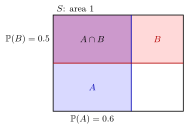
The square has area , the band has width and the band has height , so the overlap has area . Equivalently, : inside , the band still takes up , just as it does in the whole square.
The product form is the definition because it is symmetric in and and also makes sense when ; the form from the Key Results needs . Independence is a property of the probability function, not of the sets: on a fair die, and overlap, yet , so they are independent; on a loaded die the same sets need not be.
Two slips are common. Disjoint events with positive probabilities are never independent, since . And for three or more events, pairwise independence is not enough: for two fair coin tosses, "first toss heads", "second toss heads" and "both tosses equal" are pairwise independent, but all three together have probability , not . The same idea is later applied to random variables.
Key Results
- If , independence is equivalent to .
- Independence of implies independence of and of .
Examples
- Heads on two independent fair tosses have intersection probability .
- On one fair die, and are disjoint but not independent: .
Prerequisites
Related Concepts
- Conditional Probability
- Multiplication Rule for Counting
- Union and Intersection of Events
- Birthday Problem
- Disjoint Events
Sources
- Probability Theory for EOR · Week 2
- Nicky van Foreest · Probability Distributions · Refresher
Aliases: independence of events, statistically independent events Keywords: mutually independent events Symbols: intersection
Last updated: 20 October 2026 03:02
Independent EventsConditional IndependenceIndependent Random VariablesEventProbability FunctionConditional ProbabilityMultiplication Rule for CountingUnion and Intersection of EventsBirthday ProblemDisjoint Events