Indicator Random Variable
Definition
For an event , the indicator random variable equals if occurs and otherwise.
Interpretation
An indicator turns an event into a numerical yes-or-no observation: is on the outcomes in and on all others. Counting how many events occur becomes adding random variables: the number of the events that occur is , whether or not the events are independent.
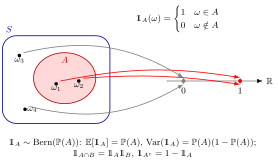
In the figure the outcomes and lie in and are sent to , while and are sent to . So takes only the values and , with : a Bernoulli variable with parameter , as in the Key Results.
Operations on events become arithmetic: exactly when both and occur, exactly when fails, and is the indicator form of the inclusion-exclusion principle. Combined with the fundamental bridge , a sum of indicators turns an expected count into a sum of probabilities.
Key Results
- .
- and .
- A sum of indicators counts the number of events that occur, even when those events are dependent.
Examples
- A fair-toss heads indicator is on heads and on tails.
- The number of heads in three tosses is .
Prerequisites
Related Concepts
Sources
- Probability Theory for EOR · Week 3
- Probability Theory for EOR · Week 4
- Nicky van Foreest · Probability Distributions · Refresher
Aliases: indicator r.v., indicator variable Keywords: event indicator Symbols: intersection, omega, union
Last updated: 20 October 2026 03:02
Indicator Random VariableFundamental BridgeVarying Life Annuity PaymentsWhole Life Annuity DueIndividual Risk ModelRating Factors and Interactions in Insurance GLMsEventRandom VariableInclusion-Exclusion PrincipleExpectationBernoulli DistributionLinearity of Expectation