Inclusion-Exclusion Principle
Definition
Let and be events. The inclusion-exclusion principle for two events states that
Interpretation
The probability that or occurs is not simply when the events overlap: the outcomes in both are counted twice, so the overlap is subtracted once. Inclusion-exclusion is this correction for double counting.
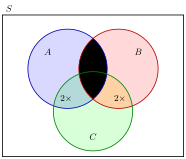
The labels show how many times each region is counted by . Subtracting the three pairwise intersections makes the regions labelled count once, but the centre lies in all three pairwise intersections and is now counted times, so the triple intersection is added back. This gives
The two-event formula follows from additivity of the probability function on disjoint pieces: is the disjoint union of and the part of outside , and is the probability of that part plus . For disjoint events the correction term is zero and the ordinary addition rule remains. In general .
For a heart or a face card from a standard deck, ; the three heart face cards would otherwise be counted twice. The same formula counts elements of finite sets, . For more events the signs keep alternating: subtract all pairwise intersections, add all triple ones, subtract all quadruple ones, and so on. A common slip is to stop after the pairwise terms.
Key Results
- For two events, inclusion-exclusion subtracts the overlap once.
- For three events, the triple overlap must be added back after pairwise overlaps are subtracted.
- The principle works for both counting and probability.
Examples
- To count students taking mathematics or statistics, add both course counts and subtract students taking both.
- In card problems, the probability of drawing a heart or a face card requires subtracting heart face cards once.
- To compute the chance of at least one of several alarms sounding, inclusion-exclusion adjusts for simultaneous alarms.
Prerequisites
Related Concepts
Sources
- Probability Theory for EOR · Week 2
Aliases: principle of inclusion and exclusion, inclusion-exclusion formula, general addition rule, sieve formula Keywords: addition rule Symbols: intersection, union
Last updated: 20 October 2026 03:02
Inclusion-Exclusion PrincipleUnion and Intersection of EventsProbability FunctionIndicator Random VariableFundamental BridgeDisjoint Events