Quantile Function
Definition
For a CDF and , its generalized inverse is
It need not be an ordinary inverse: can have flat portions or jumps. Endpoint values at are irrelevant when using a continuous uniform input.
Interpretation
The quantile function answers the reverse question of the CDF. The CDF asks for the probability of being at most ; the quantile function asks for the threshold below which a fraction of the probability lies. It converts a probability level into a value of .
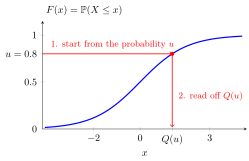
To read the figure, start at the level on the vertical axis, move right until the curve is reached, then move down to the horizontal axis: the value found there is , about for this CDF. Here is the of the Definition; when is continuous and strictly increasing, as here, it is the ordinary inverse, and .
The infimum handles the two cases in which no ordinary inverse exists. If jumps over the level , no has , and is the location of the jump. If equals on a whole interval, many have , and the infimum picks the left end. In the example the two cases together give for . By right-continuity of , is the smallest with .
Special levels have their own names: is a median, and and are the lower and upper quartiles. Feeding a uniform input into produces a variable with CDF , the universality of the uniform used to simulate a distribution.
Despite the notation, is an inverse function, not the reciprocal .
Key Results
- For , if and only if .
- Consequently, if , .
Examples
- For , .
- For , for and for .
Further Properties
The median is a quantile at probability level . Other probability levels define percentiles. The generalized inverse is useful even when an ordinary inverse does not exist.
Prerequisites
Related Concepts
- Median
- Bijection and Inverse Function
- Uniform Distribution
- Order Statistic
- Summary Measures of a Distribution
Sources
- Probability Theory for EOR · Week 5
- Nicky van Foreest · Probability Distributions · Week 2
Aliases: Quantile Function (Generalized Inverse CDF), generalized inverse CDF, inverse distribution function, inverse CDF, percent-point function, percentile function, distributional inverse, Quantile Function Symbols: element of, real numbers
Last updated: 20 October 2026 03:02
Quantile FunctionUniversality of the Uniform and CDF RealizabilityCumulative Distribution FunctionMedianBijection and Inverse FunctionUniform DistributionOrder StatisticSummary Measures of a Distribution