Probability Function
Definition
Let be a sample space and let be a sigma-algebra of events, that is, a collection of events containing and closed under complements and countable unions. A probability function is a function that assigns probabilities to events and satisfies the axioms of probability.
Interpretation
A probability function is the rule that assigns to each event a number between and saying how likely it is. Together with the sample space and the collection of events, it forms the probability model.
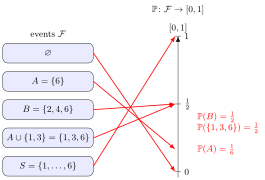
The figure maps events of a fair die roll to : , , , and . The event is the union of the disjoint events and , so its probability is . The events and show that different events can have the same probability: the function need not be injective.
The input of is an event, a set of outcomes, not an outcome: strictly one writes , and is a common shorthand. The axioms restrict which functions are allowed, but they do not choose one; that is a modelling decision. A fair die and a loaded die have the same sample space and the same events, but different probability functions. On a finite sample space, the probability function is determined by the probabilities of the single outcomes, since by additivity is the sum of over the outcomes .
Naive probability is the special case in which all single outcomes get the same probability. Conditioning on an event with produces a new probability function, (conditional probability).
Key Results
- A probability function assigns numbers to events according to the probability axioms.
- The full sample space has probability one.
- Disjoint unions are handled by adding probabilities.
Examples
- For a fair die, the probability function assigns probability one sixth to each single-face event.
- In a reliability model, the probability function assigns a probability to the event that the system fails.
- For a deck of cards, the probability function assigns probabilities to events such as drawing a heart.
Prerequisites
Related Concepts
Sources
- Probability Theory for EOR · Week 2
Aliases: probability measure Keywords: probability Symbols: element of, omega
Last updated: 20 October 2026 03:02
Probability FunctionConditional ProbabilityDistributionFundamental BridgeInclusion-Exclusion PrincipleIndependent EventsLaw of Total ProbabilityProbability Mass FunctionAlmost SurelyAxioms of ProbabilityEventFunctionSample SpaceNaive ProbabilityComplement of an Event