Event
Definition
Let be a sample space. An event is a subset whose occurrence can be assigned a probability.
Interpretation
An event is a yes-or-no statement about the result of an experiment, written as the set of outcomes for which the answer is yes. It occurs exactly when the realized outcome belongs to it.
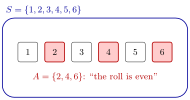
In the figure, "the roll is even" is the subset of : a roll of makes occur, a roll of does not, and with equally likely faces .
Words become set operations: " or " is the union, " and " the intersection, "not " the complement. The empty set never occurs and itself always occurs.
A common slip is to confuse the outcome with the event : only events, which are sets, are given probabilities.
Key Results
- Events are subsets of the sample space.
- Events can be combined using union, intersection, and complement.
- A probability function assigns probabilities to events, not to informal statements outside the model.
Examples
- In a die roll, the event 'roll an even number' is the set of outcomes two, four, and six.
- In a reliability model, the event 'system fails before noon' is a subset of possible histories.
- In a survey, the event 'respondent is under thirty' collects all outcomes with that property.
Prerequisites
Related Concepts
Sources
- Probability Theory for EOR · Week 1
Keywords: random event Symbols: subset
Last updated: 20 October 2026 03:02
EventAxioms of ProbabilityComplement of an EventDisjoint EventsFundamental BridgeGenerated EventIndependent EventsIndicator Random VariableNaive ProbabilityProbability FunctionUnion and Intersection of EventsAlmost SurelySample SpaceSubsetSetUnion of SetsIntersection of SetsOutcomePartition of a SetRandom Variable