Bayes Rule
Definition
Let and be events with and . Bayes' rule states that
Interpretation
Bayes' rule explains how to update a belief after new evidence is observed. It is useful when one conditional probability is easier to understand than the reverse conditional probability.
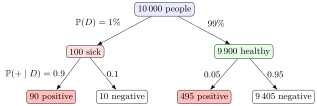
In the illustrated screening model, , and . Bayes' rule gives . Thus only about of positive tests correspond to disease, because healthy people are much more numerous.
When is one block of a partition, the law of total probability computes the denominator by summing the joint contributions from all blocks. Bayes' rule then expresses the share of that total contributed by .
Key Results
- Bayes' rule is obtained by writing in two ways using conditional probability.
- With a partition satisfying for every , and with , Bayes' rule becomes . Zero-probability blocks must be omitted from terms that condition on them.
- Base rates enter through the prior probabilities , assigned before is observed, and can strongly affect the posterior probabilities .
Examples
- A diagnostic test with high sensitivity (it detects most people who have the disease) can still have a low positive predictive value (few of its positive results are true cases) when the disease is rare.
- In spam filtering, the probability that a message is spam is updated after observing words in the message.
- In reliability analysis, a component type can be inferred from an observed failure pattern using prior component frequencies.
Prerequisites
Related Concepts
- Partition of a Set
- Multiplication Rule for Counting
- Conditional Independence
- Bayes and Total Probability: Four Forms
- Continuous Bayes Rule
Sources
- Probability Theory for EOR · Week 2
Aliases: Bayes' theorem, Bayes' formula, Bayes' rule, Bayes theorem, Bayes formula, Bayes's theorem, Bayes's rule, theorem of Bayes Symbols: intersection, sum
Last updated: 27 October 2026 11:52
Bayes RuleProsecutor's FallacyBayes Rule for BeliefsCommon PriorConditional ProbabilityLaw of Total ProbabilityPartition of a SetMultiplication Rule for CountingConditional IndependenceBayes and Total Probability: Four FormsContinuous Bayes Rule