Linearity of Expectation
Proposition
For integrable random variables and real constants , linearity of expectation states
Independence is not required. In particular, .
Interpretation
The average of a finite linear combination is the same linear combination of averages. Dependence does not affect this rule.
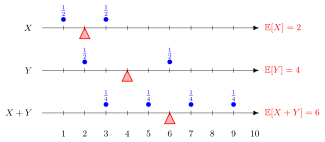
The independent variables shown have means and , so their sum has mean . Here the sum takes the values , , and , each with probability ; the identity for the means itself does not require independence.
Addition and sum forms the finite weighted sum of the variables. Expectation then averages it: distributing the probability weights across its summands explains why taking this average commutes with the finite sum.
Key Results
- For integrable , .
- .
Examples
- If and , then regardless of dependence.
- If and , then despite perfect dependence.
Prerequisites
Related Concepts
- Field
- Indicator Random Variable
- Linear Map
- Fundamental Bridge
- Adam’s Law: Total Expectation
- Variance and Standard Deviation
- Monotonicity of Expectation
Sources
- Probability Theory for EOR · Week 4
- Nicky van Foreest · Probability Distributions · Refresher
Aliases: linearity of expected value, additivity of expectation Keywords: expectation is linear Symbols: sum
Last updated: 17 October 2026 21:53
Linearity of ExpectationCovarianceExpectationAddition and SumFieldIndicator Random VariableLinear MapFundamental BridgeAdam’s Law: Total ExpectationVariance and Standard DeviationMonotonicity of Expectation