Symmetric Distribution
Definition
Let be a random variable and let . The distribution of is symmetric about if and have the same distribution.
Interpretation
A distribution is symmetric about when deviations below behave exactly like deviations above : is as likely to fall at least a distance below as at least a distance above it. The graph of the PMF or density is then a mirror image in the vertical line at .
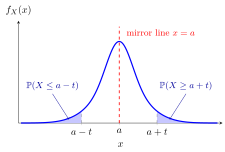
The density in the figure is symmetric about , so for every , and the two shaded tails and have the same area. This holds for every distance , not just the one drawn.
In the Definition, is the deviation above and the deviation below it; symmetry says that the two have the same distribution. An equivalent condition is for all . With and the standard normal distribution, this is the identity .
Symmetry fixes the centre. The point is a median: , and the two add up to at least , so each is at least . If the mean exists, it equals , since linearity gives , so .
The converse fails: mean and median can coincide for a distribution that is not symmetric. Symmetry is also not special to the normal distribution; the uniform distribution on and a fair die, symmetric about , are symmetric too.
Key Results
- Symmetry about a centre means left and right deviations have the same distribution.
- If the distribution is symmetric about , then is a median, and the mean equals whenever it exists.
- A symmetric distribution need not be normal.
Examples
- A normal distribution is symmetric about its mean.
- A fair die distribution is symmetric around three and a half.
- A two-point distribution with equal mass at negative one and one is symmetric about zero.
Prerequisites
Related Concepts
Sources
- Probability Theory for EOR · Week 6
Aliases: symmetry of a random variable, symmetric random variable Keywords: distribution symmetric about a point Symbols: element of, phi, real numbers
Last updated: 20 October 2026 03:02
Symmetric DistributionDistributionMedianNormal DistributionExpectationMoment