Naive Probability
Definition
Let be a finite sample space whose outcomes are equally likely. For an event , the naive probability of is
Interpretation
When a finite sample space has equally likely outcomes, the probability of an event is the share of outcomes that belong to it. Probability then becomes counting: count the favourable outcomes, count all outcomes, and divide.
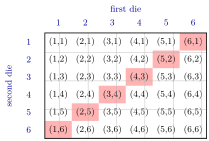
The grid lists all ordered pairs , with the first die and the second; for fair dice each cell is equally likely. The six shaded cells have sum , so . The pairs and are different cells: recording which die shows which number is what makes all outcomes equally likely.
The equal-likelihood assumption belongs to the model, not to the question, and the choice of outcomes decides whether it holds. Taking the eleven possible sums as outcomes and dividing by gives , which is wrong, because a sum of arises in six ways and a sum of in only one. The sample space must also be finite: infinitely many outcomes cannot all have the same positive probability, since their probabilities would add up to more than .
The formula satisfies the axioms of probability, because the number of elements (cardinality) of a union of disjoint sets is the sum of their numbers of elements. The multiplication rule, permutations and combinations are the tools for computing and .
Key Results
- Naive probability applies only when all outcomes in the sample space are equally likely.
- It is computed as favourable outcomes divided by total outcomes.
- Counting errors in either numerator or denominator lead directly to probability errors.
Examples
- The probability of rolling an even number on a fair die is three favourable faces out of six.
- The probability of drawing an ace from a well-shuffled deck is four favourable cards out of fifty-two.
- If a random PIN is chosen uniformly from all four-digit PINs, naive probability can compute the chance of a repeated digit pattern.
Prerequisites
Related Concepts
- Axioms of Probability
- Hypergeometric Distribution
- Probability Function
- Sampling With and Without Replacement
Sources
- Probability Theory for EOR · Week 1
Aliases: classical probability, Laplace probability, naive definition of probability, classical definition of probability Keywords: equally likely outcomes Symbols: subset
Last updated: 20 October 2026 03:02
Naive ProbabilityBirthday ProblemDiscrete Uniform DistributionSample SpaceEventCountingCardinalityAxioms of ProbabilityHypergeometric DistributionProbability FunctionSampling With and Without Replacement