Survivor Function
Definition
For a random variable with CDF , the survivor function is
Interpretation
The survivor function gives the probability of exceeding a threshold. For a lifetime or a waiting time , is the probability of still waiting, or still working, at time ; it is useful for reliability and tail probabilities.
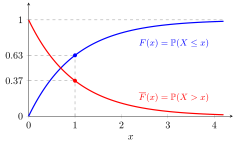
The illustrated distribution has survivor function for . At the two curves take the values and , which add up to , as they do at every . For rate , the survivor function becomes .
Many waiting-time facts are simplest in terms of the tail. The memoryless property of the exponential distribution reads , and for independent variables the minimum exceeds exactly when every variable does, so its survivor function is the product of theirs, as for the minimum of independent exponentials.
The inequality is strict: . For continuous variables this equals , but for discrete variables the two differ by .
Key Results
- is nonincreasing and right-continuous.
- For a discrete variable, , which can differ from .
Examples
- For , .
- For , but .
Prerequisites
Related Concepts
- Support of a Random Variable
- Expectation
- Memoryless Property
- Exponential Distribution
- Density of an Order Statistic
Sources
- Nicky van Foreest · Probability Distributions · Week 2
Aliases: survival function, reliability function, complementary cumulative distribution function, complementary CDF, CCDF, tail distribution function Symbols: lambda
Last updated: 20 October 2026 03:02
Survivor FunctionForce of MortalityFuture LifetimeLikelihood for Censored Loss DataOrdinary DeductiblePareto Loss ModelStochastic OrderCumulative Distribution FunctionSupport of a Random VariableExpectationMemoryless PropertyExponential DistributionDensity of an Order Statistic