Joint Probability Density Function
Definition
A random pair is jointly continuous with joint PDF if, for every Borel region , such as a rectangle, a disc or a half-plane,
Continuous marginals alone do not guarantee a joint density: with both marginals can be continuous while all the probability lies on a line.
The double Definite Integral adds density over a rectangle or other region in the joint support, giving the probability that the pair falls there.
Interpretation
A joint density describes how probability is spread over the plane: is probability per unit area near , and the probability of a region is the volume under the surface above it.
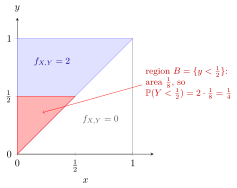
The illustrated density has height over the triangle of area , so its total volume is . The red part of the triangle below has area , so .
Any nonnegative function with total integral is a joint density. The value is not itself a probability and may exceed , as the height shows. At a point where the density is continuous, the probability of a small rectangle with sides and around that point is approximately . Without this local condition, an arbitrary point value of a density need not give the local average. Points and curves have area zero and hence probability zero, which is why the pair , whose probability lies on a line, has no joint density.
This is the one-variable density from Probability Theory with area in place of length, and the continuous counterpart of the joint PMF, with double integrals in place of double sums. From it follow marginal and conditional densities and expectations by two-dimensional LOTUS. For independent variables the joint density is the product .
The region where the density is positive fixes the integration limits. For on the triangle, runs from to , not from to ; to would give probability .
Key Results
- and .
- A region of planar area zero has probability zero under a joint density.
Examples
- For density on , .
- For density on , .
Prerequisites
Related Concepts
Sources
- Nicky van Foreest · Probability Distributions · Week 2
Aliases: joint PDF, joint density, joint density function, bivariate density Symbols: delta, element of, integral, real numbers, subset
Last updated: 27 October 2026 11:52
Joint Probability Density FunctionConditional Probability Density FunctionTwo-Dimensional LOTUS for Continuous VariablesMarginal Probability Density FunctionProbability Density FunctionDefinite IntegralJoint CDF of Continuous Random VariablesIndependent Random Variables