Generalized Markov Inequality
Theorem
Let be nonnegative and nondecreasing on a domain containing the values of and the threshold . If and , then
This follows from . For the ordinary Markov inequality , take on and require , .
The Inequality gives an upper bound, not an exact tail probability: the event where a nonnegative variable exceeds contributes at least times its probability to the expectation.
Interpretation
A nonnegative variable with a small average cannot often be large. With mean , at most a fifth of the probability can lie at or above, because that part alone would contribute at least to the mean. The generalized version applies the same reasoning to instead of .
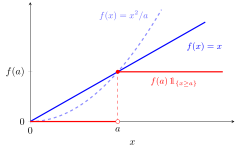
The figure compares with the step function , which is below and from onwards. Both and the steeper dashed have the value at and lie on or above the step everywhere. Taking expectations of gives , which is the theorem.
Each hypothesis is used in that one comparison: nonnegativity of covers , where the step is , and monotonicity covers , where . Without nonnegativity the bound fails: if takes the values and with probability each, then but .
Different choices of give the other tail bounds: applied to gives the Chebyshev inequality, and with gives the Chernoff bound. No single choice is always best. For , with and , the first-moment bound is smaller for and the second-moment bound is smaller for .
Key Results
- For and , .
- For , and , whenever the moment is finite.
Examples
- A nonnegative loss with mean satisfies .
- If and , then .
Prerequisites
Related Concepts
Sources
- Nicky van Foreest · Probability Distributions · Week 7
Aliases: Markov inequality, generalised Markov inequality, Markov bound Keywords: Markov's inequality Symbols: infinity, mu
Last updated: 27 October 2026 11:52
Generalized Markov InequalityChernoff BoundExpectationInequalityChebyshev Inequality