Adam’s Law with Extra Conditioning
Theorem
For random variables , and with ,
This is Adam's Law with kept as background information. Conditioning on retains all the information in , and no independence assumption is needed.
Taking for an event , letting encode a finite or countable partition and letting indicate an event gives LOTP with extra conditioning: once we condition on , we treat as the new background information and apply the ordinary LOTP inside that conditional world. Assume and omit terms with . For the remaining terms, means . The events still form a partition, but all probabilities are now computed under the assumption that has occurred:
Interpretation
Adam’s law still holds when some background information is kept fixed throughout: averaging the finer prediction over , with held fixed, gives the coarser prediction . The extra information is averaged out, the background is kept.
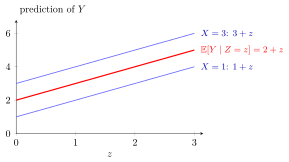
Let , where is independent of and takes and with equal probability. For each , the two blue lines and are the predictions , and the red line halfway between them is their average .
On both sides the result is a function of alone. Conditioning first on more information and then on less leaves the smaller information: for each value , the left side is for discrete and . No independence is needed, but the weights are the conditional probabilities of given ; in the figure they are and only because is independent of .
With constant the theorem is Adam’s law, and with indicators it becomes total probability with extra conditioning, as the Theorem explains.
Averaging over with its unconditional distribution is the usual slip. If and , then and both sides equal , whereas weighting by the distribution of alone would give the number .
Key Results
- For integrable , almost surely.
- Taking as an event indicator and as a partition label yields total probability with extra conditioning.
Examples
- If , is independent of , and , then .
- If is constant, the identity reduces to .
Prerequisites
Related Concepts
Sources
- Nicky van Foreest · Probability Distributions · Week 6
Symbols: infinity, intersection, sum
Last updated: 20 October 2026 03:02
Adam’s Law with Extra ConditioningAdam’s Law: Total ExpectationTotal Probability with Extra Conditioning