Moments from the MGF
Theorem
If the MGF is finite on an open interval containing , then all moments of are finite and, for every nonnegative integer ,
where denotes the th derivative of . The assumption is what justifies differentiating under the expectation.
The Moment Generating Function is an exponential expectation. Taking its Higher-Order Derivative brings down a power of each time, and evaluating at zero leaves . The finiteness assumption justifies moving those derivatives under the expectation.
Interpretation
Differentiating the MGF at zero extracts the moments of the random variable one at a time: the first derivative gives , the second gives , and so on.
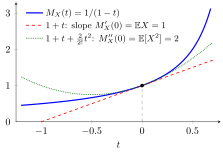
For , for . The tangent line at has slope , and the parabola , written in the legend, matches the second derivative . Hence .
The reason is the expansion . Taking expectations term by term gives near , so, as for any Taylor series, is the th derivative at , equivalently times the coefficient of . For , a geometric series for , every coefficient is , so . Finiteness of on an open interval around is what justifies the term-by-term step; without it may be infinite on one side of , and then its derivatives at are not defined.
The MGF delivers raw moments; the variance and other central moments then follow, as in . A common slip is to forget to set : at some is not a moment of .
Key Results
- and .
- .
Examples
- For , the first two derivatives at zero both equal , giving variance .
- For , the first two moments are and , giving variance .
Prerequisites
Related Concepts
Sources
- Nicky van Foreest · Probability Distributions · Week 1
Symbols: lambda
Last updated: 20 October 2026 03:02
Moments from the MGFMoment Generating FunctionHigher-Order DerivativeMomentVariance and Standard Deviation