Continuous Law of Total Probability
Theorem
For continuous random variables and for which the conditional density exists,
for every except possibly on a set of zero length, for example at finitely many points.
The left side is the Marginal Probability Density Function of the response. It is recovered by averaging the conditional densities over the other variable’s marginal law.
Interpretation
The continuous law of total probability describes a two-stage model: first is drawn, then is drawn from the conditional density . The unconditional density of is then a weighted mixture of the conditional densities, with the density of as the weight.
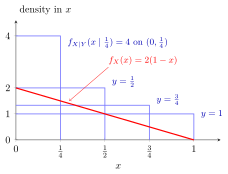
For , each conditional density is a rectangle of height on : heights , , and for . A point lies under the rectangles with only, so with on the average is for . Values near lie under few rectangles, so the red marginal decreases.
The formula is the law of total probability with the cases replaced by the values , the sum by an integral and by ; the slider illustrates finite midpoint sums, with a truncated integration range in the exponential example. Since , it is also the computation of a marginal density from the joint density.
The same integral is the normalizing denominator in the continuous Bayes rule, and the same averaging applied to means returns as Adam’s law.
The integration range is easy to get wrong: is zero unless , so the integral runs from to . Dropping the support condition and integrating the constant over all of would incorrectly give , which integrates over to rather than . Integrating over all is valid when the zero contribution outside is retained; checking total mass catches a lost support indicator.
Key Results
- The event form is .
- Integrating the conditional density mixture over gives total probability one.
Examples
- For density on , for .
- If and , then , using the event form.
Prerequisites
Related Concepts
Sources
- Nicky van Foreest · Probability Distributions · Week 2
Aliases: continuous LOTP Symbols: element of, integral, sum
Last updated: 27 October 2026 11:52
Continuous Law of Total ProbabilityContinuous Bayes RuleConditional Probability Density FunctionMarginal Probability Density FunctionBayes and Total Probability: Four FormsLaw of Total ProbabilityAdam’s Law: Total Expectation