Binomial Theorem
Theorem
For a nonnegative integer and real numbers and ,
Interpretation
Expanding the power means multiplying factors and choosing or from each factor. A product in which is chosen times equals , and the binomial coefficient counts the ways to pick those factors.
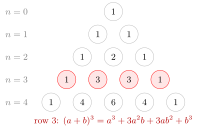
Row of Pascal's triangle lists . In the highlighted row , the coefficients belong to , , and : the term appears times, once for each choice of the two factors that supply .
In probability the theorem is used with and . The terms are then the binomial probabilities of successes in independent trials, and the theorem shows that they add up to . Weighting the th term by replaces by , so the same step gives the MGF of . With the theorem counts subsets: .
A common slip is to expand as ; already for this misses the cross term .
Key Results
- Setting , gives .
- The coefficient of is .
Examples
- .
- For two independent fair tosses, the probabilities of zero, one, and two heads are , the terms in .
Prerequisites
Related Concepts
Sources
- Nicky van Foreest · Probability Distributions · Refresher
Aliases: binomial expansion Symbols: sum
Last updated: 20 October 2026 03:02
Binomial TheoremBinomial CoefficientBinomial DistributionMultinomial Distribution