Gamma Function
Definition
Self-study material
In 2026-27 the gamma function is the self-study section of Lecture 12. It is worth knowing as an application of improper integrals, but it is not developed in class.
The gamma function is defined by an improper integral:
Interpretation
The gamma function extends the factorial from integers to all positive real arguments: for integers , and between the integers is given by the same integral. Because of the shift by one, .
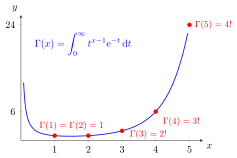
The red dots are the factorials: , , , and . The curve passes through them and also takes values in between, such as . It has its minimum between and , about near , and grows without bound as .
The link with factorials comes from integration by parts. For it gives , the same recursion as , and ; induction then gives . The integral is improper at and, for , also at ; the domain is where it converges. Near the integrand behaves like , which by the -test with is integrable exactly when . Near the factor outweighs any power, and comparison with gives convergence.
A common slip is the shift: is , not . The gamma function returns later in probability, in the formula of the gamma distribution.
Key Results
- The gamma function satisfies for all integers
- It generalizes factorial growth to real arguments.
- The domain of the gamma function can be extended further.
Examples
Prerequisites
Related Concepts
Sources
- Math I: Calculus · Lecture 12
Aliases: Euler's gamma function Symbols: gamma, infinity, integral, pi, real numbers, square root
Last updated: 27 October 2026 11:52
Gamma FunctionGamma DistributionFactorialImproper Integralp-test