Mathematical Induction
Definition
Let be a statement about a natural number . The principle of mathematical induction says: if
- base case: is true, and
- inductive step: for every natural number , implies ,
then is true for every .
This is the fifth Peano axiom, where the successor is written once addition is available. A proof by induction checks the base case and proves the inductive step. In the step, is an arbitrary but fixed natural number, and the assumption that holds is called the inductive hypothesis.
Interpretation
Induction works like a row of dominoes. The base case knocks over the first domino. The inductive step says that whichever domino falls, it knocks over the next one. Together they make every domino fall: gives , gives , and so on through all of .
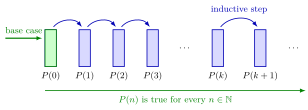
The green arrow is the base case: it pushes . Each blue arc is one instance of the inductive step, and the arc from to stands for all of them at once, because is arbitrary. The green line underneath is the conclusion: holds for every natural number .
Neither part works alone. A step without a base case is a chain of dominoes that nobody pushes, and a base case without a step knocks over only the first domino. Checking one by one is still not a proof for every .
The inductive step proves an implication. It does not claim that is true; it shows that would follow if were true. Assuming " for every " in the step would assume the very statement to be proved.
Key Results
- Set form. If contains , and whenever , then . Apply the principle to the statement "".
- Starting at . If is true and implies for every integer , then is true for every integer . Apply the principle to : "". Statements about positive integers start at .
- Both parts are needed. For : " is even", the step holds, since . But fails, and in fact is odd for every . For : " is prime", the cases are all true, but gives .
- Recursion and induction go together. The factorial is defined recursively: , and for every . Statements about a recursively defined quantity are proved by induction: the value at settles the base case, and the rule from to drives the step. Powers (, ) and multiplication on (, ) can be built the same way.
- Several variables. For a statement about and , such as , fix and induct on : the base case is for that , and the step goes from to with the same .
Examples
-
A sum formula. For every ,
Base case: for both sides are . Inductive step: assume for some . Then
which is the formula for . This is the arithmetic series .
-
Odd numbers. for every integer . For , . If , adding the next odd number gives .
-
Divisibility. is divisible by for every integer . For , . If for an integer , then
-
An inequality. for every . For , . If , then, since ,
-
From a recursive definition. With multiplication defined by and , the rule needs a proof, because stands on the right. For it is the definition. If , then .
Prerequisites
Related Concepts
Sources
- Math I: Calculus · Lecture 1 (frames "Peano axiom 5: mathematical induction", "Proof by induction: example" and "Mathematical induction is like the domino effect")
- Math I: Calculus · Tutorial 1
Aliases: proof by induction, principle of mathematical induction, induction proof Keywords: base case, inductive step, inductive hypothesis, induction hypothesis, domino effect, Peano axiom 5 Symbols: element of, natural numbers, subset
Last updated: 27 October 2026 11:52
Mathematical InductionNatural NumberAddition and SumFactorialExponentiation and PowerFinite SeriesArithmetic Series