Bounded Sequence
Definition
A sequence of real numbers is bounded if there exists a real number such that
Equivalently, the sequence is both bounded above, meaning that for every for some real number and bounded below, meaning that for every for some real number A sequence is unbounded if no such exists.
Interpretation
A bounded sequence is one whose terms all stay between and for one fixed number . The terms may move around inside this range, but none can escape it.
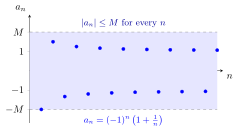
The terms of alternate in sign: , , , and so on. All of them lie in the band between and with , and shows that no smaller works. The terms approach and alternately, so this sequence is bounded but not convergent.
The absolute value measures each term's distance from zero, and the inequality must hold with one common bound for every index. The order of the quantifiers matters: "there is an such that for every " is the definition, whereas "for every there is an " holds for every sequence, with . Any larger also works, and a sequence bounded above by and below by satisfies .
Boundedness is a common hypothesis in convergence results. Every convergent sequence is bounded, so an unbounded sequence diverges. The monotone convergence theorem adds monotonicity to obtain convergence. In the figure, the even-indexed terms form a convergent subsequence with limit .
A common slip is to equate "unbounded" with "tends to infinity". The sequence with for even and for odd is unbounded, yet it does not tend to , because it keeps returning to .
Math III shows that every bounded sequence has a convergent subsequence: the Bolzano–Weierstrass theorem.
Key Results
- Every convergent sequence is bounded.
- A bounded sequence need not converge.
- Every finite sequence is bounded.
Examples
- is bounded.
- is bounded but not convergent.
Prerequisites
Related Concepts
- Cauchy Sequence
- Limit of a Sequence
- Finite Sequence
- Upper Bound
- Lower Bound
- Bounded Function
- Monotone Sequence
- Squeeze Theorem for Sequences
Sources
- Math I: Calculus · Lectures 2–3
Symbols: infinity
Last updated: 20 October 2026 03:02
Bounded SequenceMonotone Convergence TheoremSequenceAbsolute ValueInequalityCauchy SequenceLimit of a SequenceFinite SequenceUpper BoundLower BoundBounded FunctionMonotone SequenceSqueeze Theorem for Sequences