Fundamental Theorem of Calculus Part 1
Theorem
Suppose are real numbers, is a Riemann integrable function, and is the function defined as:
Then, is continuous on Moreover, if and is continuous at then is differentiable at with
Interpretation
Integrating from up to a moving point produces a new function , and this part of the fundamental theorem describes how changes: it is always continuous, and where is continuous its rate of change is the current value . In this sense differentiation undoes integration.
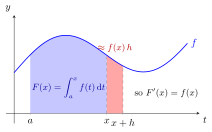
The figure shows why. Moving the right edge from to adds the thin red strip, whose area is about for small . Dividing by and letting gives . The approximation becomes exact in the limit because is continuous at , so its values on the strip are all close to .
The two conclusions need different hypotheses. Continuity of needs only integrability: a Riemann integrable is bounded, say , and then . The derivative statement needs continuity of at . Where jumps, has a corner and is not differentiable. Even a change at a single point matters: if and otherwise on , then is identically , so .
The theorem shows that every continuous function on an interval has an antiderivative, namely , and part 2 then turns integrals into differences .
Key Results
- Integration defines a continuous function.
- Differentiation recovers the original integrand at points of continuity.
- The theorem establishes a local connection between integration and differentiation.
Examples
- If then and
-
For variable limits, suppose and are differentiable at , their values stay in near , and is continuous at both and . Then:
Prerequisites
Related Concepts
Sources
- Math I: Calculus · Lecture 11
Aliases: FTC 1, first fundamental theorem of calculus Symbols: element of, integral, real numbers
Last updated: 22 October 2026 19:04
Fundamental Theorem of Calculus Part 1ContinuityDerivative and DifferentiabilityRiemann IntegralFundamental Theorem of Calculus Part 2AntiderivativeDefinite Integral