Squeeze Theorem for Functions
Theorem
Suppose that for every sufficiently close to , except perhaps at itself. If
then
For a one-sided limit, use the inequalities only on that side and replace all three limits by the matching one-sided limits.
The same statement holds for limits as or : the inequalities need only hold for sufficiently large
Interpretation
The squeeze theorem shows that a function inherits its limit from two bounding functions: if is trapped between and near and both bounds approach the same value , then has no room to do anything else and must approach as well. It is useful exactly when is hard to analyse directly but easy to bound.
Both parts of the hypothesis are needed. The limits at the point of the lower and upper bounding functions must be the same finite value: for all , but the bounds stay at and , and has no limit at . A bound on the values alone does not force a limit. The inequalities only have to hold near , except perhaps at itself, because the limit ignores the value at and everything outside a small punctured neighbourhood.
Two forms are used most often. If and , then ; this is the squeeze with the bounds and . If is a bounded function, , and , then , since . The squeeze also proves from the inequalities for .
The theorem is the function version of the squeeze theorem for sequences, and it holds in the same form for one-sided limits and limits at infinity.
Key Results
- The function must be bounded above and below by convergent functions.
- Equality of the bounding limits forces convergence.
- The theorem applies even when the middle function is difficult to analyse directly.
Examples
-
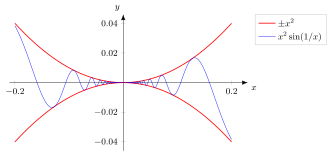
follows from squeezing between
-
Oscillatory functions can converge when tightly bounded.
Prerequisites
Related Concepts
Sources
- Math I: Calculus · Lecture 5
Aliases: sandwich theorem for functions Keywords: sandwich theorem, squeeze theorem Symbols: infinity, pi
Last updated: 20 October 2026 03:02
Squeeze Theorem for FunctionsLimit at a PointLimit at InfinitySqueeze Theorem for SequencesLimit Laws for FunctionsAsymptotic Equivalence