Extreme Value Theorem
Theorem
Let be real numbers, and let be a continuous function on Then attains its global maximum at and also attains its global minimum at
Interpretation
The extreme value theorem guarantees that a continuous function on a closed and bounded interval attains both a largest and a smallest value. It does not say where they are, only that a search for them cannot come back empty.
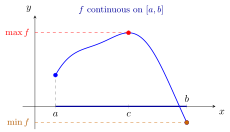
In the figure the maximum is attained at the interior point , the highest point of the graph, and the minimum at the endpoint . Both are values that actually takes, and , not merely bounds that it approaches. The theorem allows either kind of location, so the endpoints always have to be checked.
Each hypothesis is needed. On the open interval the function comes arbitrarily close to without reaching it, so it has no maximum; on the unbounded interval the same function is not even bounded above. Without continuity a jump can remove the extreme value: on , the function equal to for and to at has supremum but never takes the value . The hypotheses are sufficient, not necessary: attains its maximum on the open interval , at .
In the language of global extrema, the theorem says that a continuous on has a global maximum and a global minimum; in particular, is bounded there and its supremum is a maximum. Math III extends the theorem from closed bounded intervals to a wider class of sets in the extreme value theorem on compact sets.
Key Results
- The theorem does not apply to open or unbounded intervals.
- The theorem does not apply to functions that are not continuous.
Examples
- The function on attains the largest value and the smallest value
- The function has no maximum on
Prerequisites
Related Concepts
Sources
- Math I: Calculus · Lecture 5
Aliases: EVT, Weierstrass extreme value theorem Symbols: element of, infinity, pi, real numbers
Last updated: 20 October 2026 03:02
Extreme Value TheoremContinuityGlobal ExtremumCompact SetBounded FunctionExtreme Value Theorem on Compact Sets