Absolute Value
Definition
Let be a real number. The absolute value of is defined as follows:
Let and be real numbers. The quantity is called the distance between and and is thus denoted by i.e.,
Interpretation
The absolute value measures how far a real number lies from zero on the real line, whichever side it lies on. The case definition only removes the sign: keeps when and switches to when .
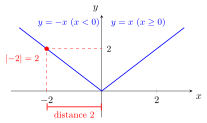
The graph is a V with its corner at the origin: the left branch is the line and the right branch is . The marked point shows : the number lies at distance from , just as does.
Applied to a difference, is the distance between and , and , so the order does not matter. This is how inequalities with absolute values should be read: describes the points within distance of , that is, the interval . This reading comes back later in the course, in the definitions of limits and continuity, and the same idea of distance is later extended to vectors and to more general spaces.
A common slip is to read as "a negative number". For the number is positive, which is exactly why there. For the same reason , not .
Key Results
- for all
- if and only if
- defines a distance function on
Examples
Prerequisites
Related Concepts
- Inequality
- Complex Absolute Value
- Trichotomy of Real Numbers
- Negation
- Euclidean Norm
- Chebyshev Inequality
Sources
- Math I: Calculus · Lecture 2
Aliases: modulus Keywords: distance on the real line Symbols: delta, element of, real numbers, square root
Last updated: 20 October 2026 03:02
Absolute ValueBounded SequenceCauchy SequencePunctured NeighbourhoodTriangle InequalityFolded Normal DistributionReal NumberInequalityComplex Absolute ValueTrichotomy of Real NumbersNegationEuclidean NormChebyshev Inequality