L'Hôpital's Rule
Theorem
Let approach through an interval. Assume that, sufficiently near :
- and are differentiable, and
- either and or and
- where may be finite or infinite.
Then
Interpretation
L’Hôpital’s rule evaluates limits of quotients that have the indeterminate form or by comparing the rates of change of the numerator and denominator. It replaces the limit of by the limit of , which is often simpler.
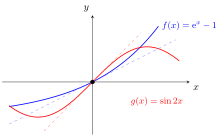
: near both functions are close to their tangents (dashed), with slopes and , so the quotient tends to the ratio of the slopes.
Each hypothesis matters. The rule needs an indeterminate form: as , while the quotient of the derivatives is . It also needs the limit of to exist: as , but has no limit. In such a case the rule gives no information, and the limit of must be found in another way.
The rule may be applied again as long as the form stays indeterminate: as , the quotient leads to and then to . Other indeterminate forms are first rewritten as a quotient of type or .
A common slip is to differentiate the quotient with the quotient rule. The rule differentiates numerator and denominator separately: it uses , not .
Key Results
- L’Hôpital’s rule applies only to indeterminate forms of type or
- Differentiability of both numerator and denominator is required in a punctured neighbourhood of the point.
- The rule must not be used to justify limits that are needed to establish the derivatives involved.
- The rule needs to have a limit finite or an infinite extended real number; if that limit does not exist, the rule gives no conclusion about
Examples
- The limit can be evaluated using L’Hôpital’s rule.
-
Although formally applicable, L’Hôpital’s rule cannot be used to justify
because the derivative of depends on this limit itself. This would result in circular reasoning.
Prerequisites
Related Concepts
Sources
- Math I: Calculus · Lecture 8
Aliases: L'Hospital's rule, L'Hopital's rule, Bernoulli's rule Symbols: element of, infinity, real numbers, union
Last updated: 27 October 2026 11:52
L'Hôpital's RuleIndeterminate FormDerivative and DifferentiabilityExtended Real NumberLimit at a PointTaylor's Theorem