Symmetry of Second Derivatives
Theorem
Let be open, let , and let . If the two mixed second-order partial derivatives
exist on a neighbourhood of and are continuous at , then
Interpretation
When a function is smooth enough, differentiating first in one coordinate direction and then in another gives the same result as doing those two steps in the opposite order.
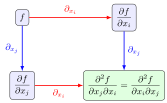
The order of differentiation does not matter: if both mixed partials exist and are continuous at , they coincide there. Consequence: the Hessian of a function is symmetric. Example: has .
Twice continuous differentiability is a convenient sufficient hypothesis ensuring the displayed mixed partials are continuous. The stated theorem only needs the specified mixed partials locally; it should not be read as saying every weaker existence assumption implies symmetry.
Key Results
- A function automatically satisfies the hypotheses of the theorem for second-order mixed partial derivatives.
- For scalar-valued functions, the Hessian matrix is symmetric.
- The same idea extends to higher-order partial derivatives when the required higher-order derivatives are continuous.
Examples
- For , the mixed derivatives and agree at every point because the function is smooth.
- For , the derivatives and both equal .
Prerequisites
Related Concepts
Sources
- Math IV: Multivariate Calculus · Week 1, Lecture 1
Aliases: Schwarz's theorem, Clairaut's theorem, Young's theorem, Schwarz–Clairaut theorem Keywords: equality of mixed partials Symbols: element of, partial, real numbers, subset
Last updated: 17 October 2026 21:53
Symmetry of Second DerivativesSecond-Order Partial DerivativeTwice Continuous Differentiability on R^nHessian MatrixHigher-Order Symmetry of PartialsContinuity between Metric Spaces