Convex and Concave Functions on 
Definition
Let be convex. A function is convex if for all and all ,
It is concave if the inequality is reversed.
Interpretation
A convex function lies below the straight interpolation of its values. A concave function lies above that interpolation.
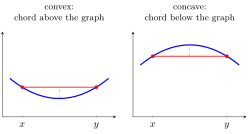
The two graphs illustrate the segment test: on a convex domain , apply the defining inequality to every segment joining . Reversing the inequality gives concavity; equivalently, is concave if and only if is convex. For a twice continuously differentiable function on an open convex domain, the Hessian test checks positive semidefiniteness for convexity and negative semidefiniteness for concavity.
A convex domain keeps the interpolated input inside the domain, so its function value is defined. The convexity inequality then compares this output with the same weighted interpolation of the endpoint outputs.
Key Results
- For convex functions, every local minimum is a global minimum.
- For concave functions, every local maximum is a global maximum.
- If is strictly convex, it has at most one minimizer on ; if is strictly concave, it has at most one maximizer on
Examples
- The function is convex on .
- The function is concave on .
Prerequisites
Related Concepts
Sources
- Math IV: Multivariate Calculus · Week 4, Lecture 1
Keywords: convex function on Rn, concave function on Rn, multivariable convexity Symbols: element of, infinity, lambda, real numbers, subset
Last updated: 27 October 2026 11:52
Convex and Concave Functions on R^nHessian Test for Convexity and ConcavityConvex Set in R^nFunctionGlobal Maximum and Minimum on \(\mathbb{R}^n\)Convexity and Concavity