Convex Set in 
Definition
A set is convex if for every and every ,
Equivalently, the whole line segment between any two points of lies inside .
Interpretation
A convex set contains, with any two of its points, the whole straight segment between them. In optimization terms: moving in a straight line from one feasible point to another never leaves the feasible region.
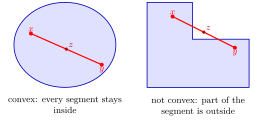
The left region is an ellipse, so every segment between its points stays inside. The right region is the union of the rectangles and . Both and lie in it, but their midpoint lies in neither rectangle. This one segment proves that the right set is not convex; convexity needs every pair of points.
As runs from to , the point moves along the segment from to (parametric representation of a line); the two weights are nonnegative and add up to . If and , then , so a half-space is convex, and so is every intersection of half-spaces, such as the feasible region of a linear program. Unions behave differently: two disjoint discs together are not convex.
In a segment is an interval , which is why convexity of a function was defined on an interval. A convex function on needs a convex domain for the same reason: must be defined.
Convex sets need not be closed or bounded: an open ball, a half-space and itself are convex.
Key Results
- Intersections of convex sets are convex.
- Euclidean open balls, closed balls, half-spaces, and affine subspaces are convex. The same ball conclusion holds for norm-induced metrics, but not for arbitrary metrics.
- A feasible region described by linear equality and weak linear inequality constraints is convex.
Examples
- The set is convex because it is a half-space.
- The unit disk is convex, but the unit circle is not.
Prerequisites
Related Concepts
Sources
- Math IV: Multivariate Calculus · Week 4, Lecture 1
Aliases: convex set in rn, convex set Keywords: convex subset, line segment property Symbols: element of, lambda, real numbers, subset
Last updated: 27 October 2026 11:52
Convex Set in R^nConvex and Concave Functions on R^nReal Coordinate SpaceVectorGlobal Maximum and Minimum on \(\mathbb{R}^n\)Inequality