Value Function
Definition
For a parametric optimization problem, the value function assigns to each parameter value the optimized objective value. For example,
when solves the problem at parameter .
Interpretation
The value function records the best achievable outcome after the decision variables have been chosen optimally.
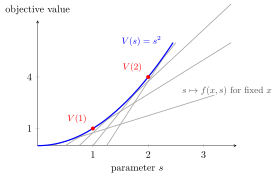
is the best value attainable at : its graph is never below any single curve with fixed (grey) and touches the curve of ; here , for instance with .
A global maximum or minimum determines the best feasible objective at each parameter value. When several optimizers attain it, they give the same value; recording only a local optimum would not in general define the global value function.
Key Results
- The value function depends on parameters, not directly on arbitrary feasible choices.
- Envelope theorems provide formulas for derivatives of value functions under regularity conditions.
- A value function can be nonsmooth if the optimizer changes abruptly or constraints switch status.
Examples
- If is the maximum utility attainable with income , then is a value function.
- If is maximum profit when available capital is , then changing changes the optimization problem and hence the value.
Prerequisites
Related Concepts
- Envelope Theorem for Constrained Optimization
- Shadow Price in Constrained Optimization
- Method of Lagrange for Equality Constraints
Sources
- Math IV: Multivariate Calculus · Week 6, Lecture 1
Aliases: optimal value function, indirect objective function, indirect objective, maximum value function Symbols: real numbers
Last updated: 17 October 2026 21:53
Value FunctionShadow Price in Constrained OptimizationParametric Constrained Optimization ProblemGlobal Maximum and Minimum on \(\mathbb{R}^n\)Envelope Theorem for Constrained OptimizationMethod of Lagrange for Equality Constraints