Parametric Constrained Optimization Problem
Definition
A parametric constrained optimization problem is an optimization problem whose objective, constraints, or feasible set depend on a parameter. A typical equality-constrained maximization problem has the form
The parameter is not optimized over; it changes the problem being solved.
Interpretation
A parametric problem asks how the best choice and best value move when outside conditions change.
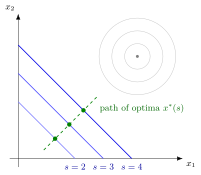
In the figure, the parameter sets the constraint level , and . The blue lines show different feasible sets, the grey circles are level sets of , and the dashed path follows the corresponding optima .
At a fixed parameter value, the equality-constraint Lagrange method handles the equality example. If inequalities are present, the inequality-constrained maximization method also imposes multiplier signs and complementary slackness. Only after solving each fixed-parameter problem does one study how its optimizer and value change.
Key Results
- The optimal value as a function of the parameter is the value function.
- Envelope theorems give derivatives of the value function without fully differentiating the optimizer.
- Constraint multipliers often measure the marginal value of relaxing parameterized constraints.
Examples
- A firm may maximize profit over inputs while the wage rate is a parameter.
- A consumer may maximize utility over bundles while income is a parameter in the budget constraint.
Prerequisites
- Method of Lagrange for Equality Constraints
- Method of Lagrange for Inequality-Constrained Maximization
Related Concepts
- Value Function
- Envelope Theorem for Constrained Optimization
- Shadow Price in Constrained Optimization
Sources
- Math IV: Multivariate Calculus · Week 6, Lecture 1
Aliases: parameterized constrained optimization Keywords: parametric optimization problem, comparative statics problem
Last updated: 17 October 2026 21:53
Parametric Constrained Optimization ProblemValue FunctionMethod of Lagrange for Equality ConstraintsMethod of Lagrange for Inequality-Constrained MaximizationEnvelope Theorem for Constrained OptimizationShadow Price in Constrained Optimization