Twice Continuous Differentiability on 
Definition
Let be open and let be a function.
The function is continuously differentiable, or , on if all first-order partial derivatives of exist on and are continuous on .
The function is twice continuously differentiable, or , on if all second-order partial derivatives of exist on and are continuous on .
Interpretation
A function has first-order partial derivatives that change without jumps, so its slopes in the coordinate directions at nearby points are close to each other. asks the same one level deeper, of the second-order partial derivatives.
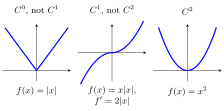
The three graphs show the classes for . is continuous but has a corner at , so it is not differentiable there; has derivative , continuous but again with a corner at , so it is but not . Each class lies inside the previous one: .
Continuity of the partial derivatives is required, not just their existence: the function with has both partial derivatives at every point, yet it equals on the line away from the origin, so it is not even continuous at the origin. Continuous partial derivatives rule this out: a function is totally differentiable, as the Key Results state.
This is the -variable form of the differentiability class from Math I, with partial derivatives in place of and . is the assumption behind the symmetry of mixed partial derivatives, hence of a symmetric Hessian, and of the second-order Taylor approximation.
A common slip is to read "differentiable everywhere" as . In one variable, with is differentiable at every point, but for has no limit at , so is not .
Key Results
- A function on an open set is totally differentiable at every point of that set.
- A scalar function has symmetric mixed second derivatives.
- Polynomials and the usual elementary smooth functions are on the interior of their domains.
Examples
- The function is on .
- The function is not on , because it is not differentiable at .
Prerequisites
Related Concepts
Sources
- Math IV: Multivariate Calculus · Week 1, Lecture 1
Aliases: twice continuously differentiable Keywords: twice continuously differentiable, C2 function on Rn, C1 function on Rn Symbols: real numbers, subset
Last updated: 20 October 2026 03:02
Twice Continuous Differentiability on R^nSymmetry of Second DerivativesOpen and Closed Sets in a Metric SpacePartial DerivativeContinuity between Metric SpacesTotal Derivative as a Linear MapDifferentiability Class