Multivariable Chain Rule
Theorem
Let , , let , and let . If is differentiable at , , and is differentiable at , then is differentiable at and
Interpretation
Local changes pass through the inner map first and then through the outer map. This is why the derivative matrices multiply in the same order as the composition acts on changes.
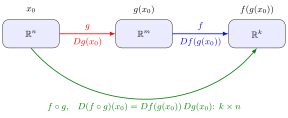
The local linear approximations compose in the same order as the maps. Near , the derivative of is the product of the matrix and the matrix ; reversing that order is generally invalid.
The Jacobian matrices represent the derivatives as linear maps. Their ordered product first applies the derivative of the inner function and then the derivative of the outer function; reversing the order is generally invalid and can even give incompatible dimensions.
Key Results
- If and , then the product has size .
- If both maps are continuously differentiable near the relevant points, their composition is continuously differentiable near .
Examples
- If and , then .
- If and , the formula gives the curve derivative .
Prerequisites
Related Concepts
Sources
- Math IV: Multivariate Calculus · Week 1, Lecture 2
Aliases: multivariate chain rule Keywords: general chain rule, Jacobian chain rule, chain rule for Jacobians Symbols: element of, real numbers, subset
Last updated: 17 October 2026 21:53
Multivariable Chain RuleJacobian MatrixComposition of FunctionsChain Rule on a CurveMultivariate Taylor Approximations