Unconstrained Extrema Conditions
Theorem
Let be open and let .
If is and has a local extremum at an interior point , then
If is , then a local maximum has negative semidefinite and a local minimum has positive semidefinite. Conversely, if is a critical point, a negative definite Hessian gives a strict local maximum, a positive definite Hessian gives a strict local minimum, and an indefinite Hessian gives a saddle point.
Interpretation
At an interior unconstrained optimum, no direction may give a first-order gain, so the derivative must vanish. The Hessian then describes the local curvature and decides the type of critical point when it is definite or indefinite.
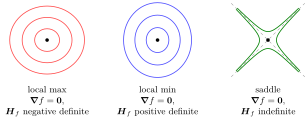
Around a local maximum (Hessian negative definite) and a local minimum (positive definite) the level curves are closed; the saddle panel uses the level curves , and the zero level set through the point is the pair of dashed crossing lines . The level curves alone do not tell a maximum from a minimum; the definiteness of the Hessian does.
If , a small step along the gradient raises and a step against it lowers (steepest ascent direction), so cannot be an extremum. This needs room in every direction, which is why is open: on , has its maximum at the endpoint , where its one-sided derivative is . At a critical point, the second-order Taylor approximation reduces to , so the sign of this quadratic form decides. Between the necessary (semidefinite) and sufficient (definite) conditions there is a gap: at the origin, has a minimum and has neither, though both have Hessian .
This is the -variable form of the first-order condition and the second-order condition on ; definiteness is checked with Sylvester's criterion. The conclusions are local. For a convex function, however, every critical point is a global minimizer.
Key Results
- First-order stationarity is necessary but not sufficient.
- Semidefinite Hessians can make the second-order test inconclusive.
- An indefinite Hessian at a critical point means the point is neither a local maximum nor a local minimum.
Examples
- For , the Hessian is positive definite and the origin is a strict local minimum.
- For , the Hessian is indefinite and the origin is a saddle point.
Prerequisites
Related Concepts
Sources
- Math IV: Multivariate Calculus · Week 4, Lecture 1
Keywords: FONC, SONC, SOSC, Hessian test for extrema Symbols: real numbers, subset
Last updated: 27 October 2026 11:52
Unconstrained Extrema ConditionsCritical PointHessian MatrixDefinite MatrixLocal Maximum and Minimum on \(\mathbb{R}^n\)Multivariate Taylor Approximations