Higher-Order Symmetry of Partials
Theorem
Let have continuous partial derivatives up to order on an open neighbourhood of . Then any two th-order partial derivatives that differentiate with respect to the same variables the same number of times are equal at .
For third-order derivatives this means, for example,
whenever the required third-order partial derivatives are continuous near .
Interpretation
When the function is smooth enough, only the number of times each direction is used matters, not the order in which the differentiations are performed.
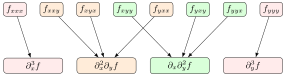
The top row shows the eight formal third-order partials in two variables. For a function, they fall into four groups according to how often each variable is used, for example . More generally, symmetry reduces the ordered partials of a function to at most distinct values.
The differentiability class packages the hypothesis that all partial derivatives through order exist and are continuous. This regularity permits repeated interchange of the order of differentiation; existence of derivatives alone is insufficient.
Key Results
- The second-order case is the usual symmetry of mixed partial derivatives.
- For a sufficiently smooth scalar function, the third derivative tensor is symmetric under permutations of its indices.
- Without the needed continuity assumptions, mixed partials can fail to agree.
Examples
- For , the derivatives , , and agree because is a polynomial.
- For , at every point because all partial derivatives are continuous.
Prerequisites
Related Concepts
Sources
- Math IV: Multivariate Calculus · Week 2, Lecture 1
Aliases: clairaut theorem higher order Keywords: symmetry of higher-order partials, equality of mixed partials
Last updated: 17 October 2026 21:53
Higher-Order Symmetry of PartialsHigher-Order Partial DerivativeDifferentiability ClassSymmetry of Second DerivativesThird-Order Derivative Tensor