Independent Linear Constraint System
Definition
A linear constraint system
with has independent constraints if the rows of are linearly independent, equivalently
For nonlinear equality constraints , the corresponding local condition at is that the gradients are linearly independent.
Interpretation
Independent constraints each remove a genuinely new direction. Dependent constraints repeat information and can make multiplier tests misleading.
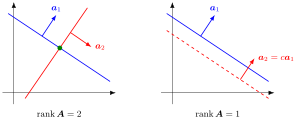
On the right, the rows of are dependent and . The corresponding parallel lines either have no common solution or coincide along a whole line. On the left, the two independent constraints have rank and meet at one point. The arrows and are the rows of , each normal to its line; on the right for a scalar .
The rank counts independent rows. Equality to means that no constraint equation is an algebraic consequence of the others; for nonlinear constraints the same check applies to their gradients at the chosen point.
Key Results
- For independent equality constraints in , the linearized feasible directions (the null space of the constraint matrix or Jacobian) form an -dimensional space, by the rank-nullity theorem.
- Independence is a rank condition on the constraint Jacobian.
- Nondegenerate constraint qualification is the nonlinear optimization version of this idea.
Examples
- The constraints and are dependent because the second repeats the first.
- The constraints and are independent because the matrix has rank .
Prerequisites
Related Concepts
Sources
- Math IV: Multivariate Calculus · Week 3, Lecture 2
Aliases: independent constraints Keywords: independent linear constraints, linearly independent constraints, constraint rank Symbols: element of, nabla gradient, real numbers
Last updated: 27 October 2026 11:52
Independent Linear Constraint SystemQuadratic Form on a Constraint SetRankGradientMatrixNondegenerate Constraint QualificationBordered Matrix Test