Steepest Ascent Direction
Theorem
Let be differentiable at , and suppose . Among all unit vectors , the directional derivative
is maximized when
The maximum value is , and the minimum value is in the opposite direction.
Interpretation
The gradient points in the direction in which the function rises fastest, and its length is that fastest rate. It answers the question: among all steps of the same small length from , which direction gives the largest first-order increase of ?
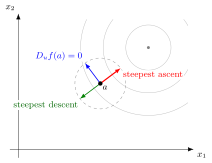
The grey circles are level curves of around a peak, and the dashed circle holds the unit directions at . For a unit vector at angle to the gradient, : the rate is largest at (red, towards the peak), most negative at (green), and zero at (blue), along the level curve through . So the gradient is perpendicular to that level curve.
The factor is the Cauchy-Schwarz inequality at work: for every unit vector , with equality exactly when . Both hypotheses matter. Differentiability makes every directional derivative equal to ; partial derivatives alone do not: for with , both partial derivatives at the origin are , yet the rate along is . And if , there is nothing to normalize and no preferred direction.
A common slip is to use the gradient itself as the direction: is not the steepest rate, because directional derivatives are taken along unit vectors. The same reasoning returns later in the course: at an interior local maximum no direction may give a positive rate, which forces (unconstrained extrema conditions).
Key Results
- The result follows from the Cauchy-Schwarz inequality.
- The direction of steepest descent is .
- If , then every directional derivative is zero and there is no unique steepest direction from first-order information.
Examples
- For at , , so the steepest ascent direction is .
- For at any point, , so the steepest ascent direction is .
Prerequisites
Related Concepts
Sources
- Math IV: Multivariate Calculus · Week 1, Lecture 1
Aliases: direction of steepest ascent, steepest direction Keywords: maximum directional derivative Symbols: nabla gradient, pi, real numbers, square root, subset, theta
Last updated: 27 October 2026 11:52
Steepest Ascent DirectionGradientDirectional DerivativeEuclidean NormChain Rule on a CurveUnconstrained Extrema Conditions