Left and Right Inverses
Definition
Let be a function. A left inverse of is a function such that
A right inverse of is a function such that
Interpretation
A left inverse undoes the function after the function is applied. A right inverse gives a way to hit every target value.
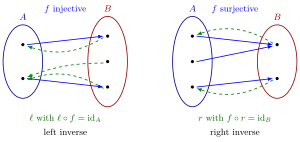
The left inverse sends each image point back to its original input; it can take arbitrary values on unused points of . The right inverse chooses one preimage for every point of .
The equations use composition: applying after must recover the identity function on the input set for a left inverse. A right inverse instead makes applying after recover the identity on the output set.
Key Results
- A function has a left inverse only if it is injective.
- A function has a right inverse only if it is surjective. Conversely, a surjective function has a right inverse, obtained by choosing one preimage for every output.
- A two-sided inverse is both a left inverse and a right inverse.
Examples
- The inclusion , , has a left inverse .
- The projection , , has a right inverse .
Prerequisites
Related Concepts
Sources
- Math IV: Multivariate Calculus · Week 3, Lecture 1
- Math V: Advanced Linear Algebra · Week 7 (revisited)
Aliases: one-sided inverse Keywords: left inverse, right inverse Symbols: real numbers
Last updated: 20 October 2026 03:02
Left and Right InversesGeneralized InverseComposition of FunctionsIdentity FunctionInjective FunctionSurjective FunctionBijection and Inverse Function