Hessian Test for Convexity and Concavity
Theorem
Let be convex and open, and let be twice continuously differentiable.
Then is convex on if and only if is positive semidefinite for every .
The function is concave on if and only if is negative semidefinite for every .
If is positive definite for every , then is strictly convex. If is negative definite for every , then is strictly concave.
Interpretation
The Hessian test turns the geometric question of bending upward or downward into a matrix definiteness check at every point of the domain. It extends the one-variable criterion that a twice-differentiable function on an open interval is convex if and only if there (convexity and concavity).
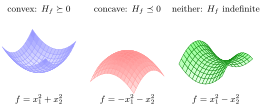
The bowl has Hessian at every point, positive definite, so it is strictly convex; the dome has and is strictly concave. The saddle has the indefinite Hessian : along the -axis the graph bends up, along the -axis down, so it is neither.
The test reduces to one variable. On the segment from to , put and ; the chain rule, applied twice, gives
and is convex exactly when every such is. So the condition must hold at every point of , and must be convex, or segments leave the domain: has on , but the segment from to crosses the gap, so convexity there is not even defined. Definiteness at a general point is checked with Sylvester's criterion: for in the interactive example the leading minors are and everywhere.
The strict statement only goes one way: is strictly convex, but its Hessian is only positive semidefinite, not positive definite, on the coordinate axes (where or ). The test pays off in optimization, because for a convex function every local minimum is a global minimum.
Key Results
- Positive semidefinite Hessian everywhere is equivalent to convexity under the stated smoothness and convex-domain assumptions.
- Negative semidefinite Hessian everywhere is equivalent to concavity under the same assumptions.
- Positive definiteness everywhere is sufficient for strict convexity, but not necessary in every case.
Examples
- For , , so is strictly convex.
- For , , so is strictly concave.
Prerequisites
Related Concepts
- Principal Minors and Sylvester's Criterion
- Global Maximum and Minimum on
- Unconstrained Extrema Conditions
Sources
- Math IV: Multivariate Calculus · Week 4, Lecture 1
Keywords: Hessian convexity test, Hessian concavity test, second derivative convexity test Symbols: element of, real numbers, subset
Last updated: 27 October 2026 11:52
Hessian Test for Convexity and ConcavityHessian MatrixDefinite MatrixConvex and Concave Functions on R^nPrincipal Minors and Sylvester's CriterionGlobal Maximum and Minimum on \(\mathbb{R}^n\)Unconstrained Extrema Conditions