Lagrangian Function
Definition
For a constrained optimization problem with objective and equality constraints , a Lagrangian function is an auxiliary function that combines the objective and the constraints with multiplier variables. Under the course convention for equality constraints,
For inequality constraints, the same idea is used with sign conventions chosen so that multiplier restrictions match the direction of the inequality.
Interpretation
The Lagrangian rewrites a constrained problem as one expression whose stationary points encode both the objective trade-off and the constraint equations.
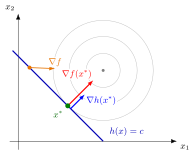
At the illustrated candidate , the gradients of and are parallel. At the orange point they are not, so moving along can improve . The differentiability and rank assumptions for the multiplier test are stated in the equality-constraint method.
The Lagrangian is a function of both the decision variables and the multipliers. Partial differentiation with respect to a multiplier recovers its constraint residual; differentiation with respect to a decision variable gives the corresponding stationarity equation.
Key Results
- Differentiating with respect to the multiplier variables recovers the constraints.
- Differentiating with respect to the choice variables gives the first-order balance between objective gradients and constraint gradients.
- Changing the sign convention changes multiplier signs, but not the underlying candidate points when handled consistently.
Examples
- For subject to , one convention uses .
- For subject to , one can use .
Prerequisites
Related Concepts
Sources
- Math IV: Multivariate Calculus · Week 4, Lecture 2
- Math IV: Multivariate Calculus · Week 5, Lecture 1
- Math IV: Multivariate Calculus · Week 7, Lecture 1
Aliases: Lagrangian, Lagrange function, constrained optimization Lagrangian, Lagrangean Keywords: ordinary Lagrangian Symbols: mu, sum
Last updated: 26 October 2026 00:09
Lagrangian FunctionEnvelope Theorem for Constrained OptimizationKuhn-Tucker LagrangianLagrange MultiplierMethod of Lagrange for Constrained MinimizationMethod of Lagrange for Equality ConstraintsMethod of Lagrange for Inequality-Constrained MaximizationFunctionGradient