Higher-Order Partial Derivative
Definition
A higher-order partial derivative is obtained by differentiating a partial derivative again with respect to one or more variables. For example, for ,
is a third-order partial derivative, when all indicated derivatives exist. In this notation the derivative written closest to (here ) is taken first; many texts instead read subscripts from left to right, so that For functions both readings give the same value.
Interpretation
Higher-order partial derivatives measure how earlier rates of change themselves change as one moves in chosen coordinate directions. They play the role that and play for a function of one variable (higher-order derivative).
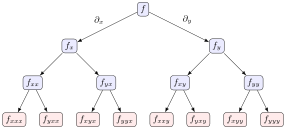
Each arrow differentiates once more, in to the left and in to the right, so the rows hold the , and partial derivatives of order , and . In variables there are ordered partials of order . As in the Definition, the new variable is written on the left, so is obtained from .
Texts that read subscripts from left to right write these labels in reverse order. For functions the two readings agree, because then the order of differentiation does not matter (higher-order symmetry of partials). The eight third-order partials of a function of then take at most four values, , , and . Without continuity the order can matter: for with , the two mixed second partials at the origin are and .
The second-order partials of a scalar function form its Hessian matrix, the third-order ones fill the third-order derivative tensor, and both supply the higher terms of multivariate Taylor approximations.
A common slip is to read as . For from the Examples, , so , while .
Key Results
- Second-order partial derivatives form the Hessian matrix when they exist.
- Third-order partial derivatives can be arranged in a three-dimensional array.
- Continuity assumptions are usually needed before changing the order of differentiation.
Examples
- For , and .
- For , and .
Prerequisites
Related Concepts
Sources
- Math IV: Multivariate Calculus · Week 2, Lecture 1
Aliases: higher partial derivative Keywords: third-order partial derivative, iterated partial derivative Symbols: partial, real numbers, subset
Last updated: 20 October 2026 03:02
Higher-Order Partial DerivativeHigher-Order Symmetry of PartialsThird-Order Derivative TensorPartial DerivativeSecond-Order Partial DerivativeMultivariate Taylor Approximations