Second-Order Sufficient Conditions for Constrained Optimization
Theorem
Let be the Lagrangian of a constrained problem. Consider a first-order candidate at which the multiplier of every binding inequality constraint is nonzero. Collect the binding inequality constraints and all equality constraints in , let be the number of active constraints (written on the bordered Hessian page, where all constraints are equalities), and assume that their gradients at are linearly independent (nondegenerate constraint qualification, NDCQ). The relevant bordered Hessian, with the Hessian of with respect to , is
Each branch also requires the first-order conditions for its own optimization direction, including feasibility and the correct inequality-multiplier signs. With , the course uses for maximization with and for minimization with . If minimization constraints are instead kept as with this same , their multipliers must satisfy . Equality multipliers are unrestricted.
Inspect the last leading principal minors after ignoring the first leading minors. A candidate satisfying the maximization first-order conditions is a strict local constrained maximizer if these minors alternate in sign and the last one has sign . A candidate satisfying the minimization first-order conditions is a strict local constrained minimizer if these minors all have sign . A maximization candidate cannot be reclassified as a minimum from the curvature signs alone.
Interpretation
The bordered Hessian checks curvature only along feasible directions. It is the constrained counterpart of using the Hessian in an unconstrained second-order test.
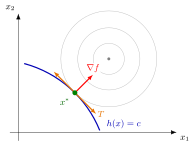
In the figure, the level set of touches the constraint curve at the first-order candidate , where is parallel to . The orange arrows mark tangent directions . Under the maximization assumptions, negative curvature for every nonzero feasible tangent direction gives a strict local constrained maximum. Positive curvature gives a strict minimum only when the minimization first-order conditions also hold. For multiple active constraints, use and the bordered-Hessian sign test above.
The mixed-constraint Lagrange method supplies the first-order candidate and its multipliers. The second-order test then examines the Lagrangian curvature on the feasible tangent directions, under the strict active-multiplier and regularity hypotheses stated above.
Key Results
- Only binding inequality constraints and equality constraints enter the relevant bordered Hessian.
- The nonzero multipliers on binding inequality constraints are part of the theorem, so check them before applying the test. If a binding inequality has a zero multiplier, the test does not apply.
- Check the first-order multiplier signs for the chosen maximization or minimization problem before testing curvature.
- The theorem gives sufficient conditions for strict local constrained optima.
- Zero or semidefinite cases can be inconclusive.
Examples
- With one equality constraint in two variables, the relevant bordered Hessian is a three-by-three matrix.
- For a maximization problem with three variables and one active constraint, the final relevant determinant must have sign .
Prerequisites
Related Concepts
Sources
- Math IV: Multivariate Calculus · Week 6, Lecture 2
Keywords: constrained SOSC, bordered Hessian sufficient conditions Symbols: lambda, mu, nabla gradient, sum
Last updated: 27 October 2026 11:52
Second-Order Sufficient Conditions for Constrained OptimizationMethod of Lagrange for Mixed ConstraintsHessian MatrixBordered Matrix TestUnconstrained Extrema Conditions