Chain Rule on a Curve
Theorem
Let be an interval and let be a differentiable curve. Its velocity at is
If is an open set containing and is differentiable at , then
Interpretation
A curve describes motion through a multivariable state space. The chain rule says the value changes by combining the system's velocity with the local sensitivity of the function of several variables.
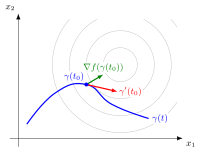
The chain rule gives . In the figure, the velocity has a positive component along the gradient, so increases along the curve at . The grey circles are level sets of .
A path assigns a position to each parameter value. Composing it with restricts to that motion; differentiating the composition pairs the derivative of with the path velocity.
Key Results
- The derivative of is the total derivative of applied to the velocity of .
- If the velocity is a unit vector, the formula is a directional derivative.
- The curve case is the one-dimensional input version of the multivariable chain rule.
Examples
- If and , then .
- If and , then .
Prerequisites
Related Concepts
Sources
- Math IV: Multivariate Calculus · Week 1, Lecture 2
Aliases: chain rule along a curve, curve chain rule, chain rule for curves, chain rule along a path Keywords: velocity along a curve, derivative along a path Symbols: element of, gamma, nabla gradient, real numbers, subset
Last updated: 22 October 2026 19:04
Chain Rule on a CurvePath in a Metric SpaceTotal Derivative as a Linear MapDirectional DerivativeMultivariable Chain Rule