Lagrange Multiplier
Definition
A Lagrange multiplier is an auxiliary variable attached to a constraint in a Lagrangian. For equality constraints , a typical course convention writes
At a regular constrained optimum, the multipliers make the gradient of the objective a linear combination of the gradients of the active constraints.
Interpretation
A multiplier records how a constraint enters the first-order trade-off at a candidate optimum. In parameterized problems, it can also measure the marginal value of relaxing a constraint.
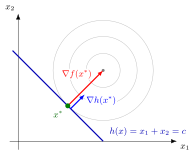
At the illustrated optimum, , so the level set of is tangent to the constraint curve. The figure maximizes , whose level sets are circles about , subject to . The optimum is , where , so . Under the sensitivity assumptions stated for the envelope theorem, measures the marginal value of changing the constraint level. In the figure, the optimal value for level is , and .
Key Results
- Equality multipliers may be positive, negative, or zero.
- Inequality multipliers have sign restrictions under the course convention.
- In the envelope theorem, some multipliers can be interpreted as shadow prices.
Examples
- Maximize subject to . With , stationarity gives and , so ; the constraint then gives and , with maximum . Raising the budget from to raises the maximum to , an increase of : the multiplier is the marginal value of the budget.
- Minimize subject to . For , stationarity gives and , so . The constraint gives and , with minimum value . For level the minimum is , whose derivative at is .
Prerequisites
Related Concepts
- Method of Lagrange for Equality Constraints
- Envelope Theorem for Constrained Optimization
- Kuhn-Tucker Conditions with Nonnegativity Constraints
Sources
- Math IV: Multivariate Calculus · Week 4, Lecture 2
- Math IV: Multivariate Calculus · Week 6, Lecture 1
Aliases: Kuhn-Tucker multiplier, KKT multiplier Keywords: multiplier, constraint multiplier, lambda multiplier, mu multiplier Symbols: mu, nabla gradient, sum
Last updated: 17 October 2026 21:53
Lagrange MultiplierComplementary SlacknessKuhn-Tucker Conditions with Nonnegativity ConstraintsKuhn-Tucker LagrangianMethod of Lagrange for Constrained MinimizationMethod of Lagrange for Equality ConstraintsMethod of Lagrange for Inequality-Constrained MaximizationShadow Price in Constrained OptimizationGradientLagrangian FunctionEnvelope Theorem for Constrained Optimization