Level Set and Level Curve
Definition
Let be a real-valued function defined on a set . A level set is defined as the preimage of a singleton set , i.e.,
When the number of independent variables is two, a level set is called a level curve, also known as contour line.
Interpretation
A level set collects all inputs at which takes one prescribed value : it answers the question "where is equal to ?". For a function of two variables these sets are usually curves in the plane, like contour lines on a map, where all points on one line have the same height.
As the preimage of , the level set lies in the domain , not on the graph. For it is the horizontal cut of the graph at height , projected onto the plane of the inputs. Despite the name, a level set need not be a curve: it is empty when is not a value of , a single point for , and all of when is constant and is its value.
A family of level curves can be read like a contour map. For equally spaced values of , level curves that lie close together mean that changes quickly there. For the curves for are circles with radii , so the gaps , , shrink as grows faster further out.
In economics, indifference curves of a utility function and isoquants of a production function are level curves. This idea returns later in optimization with an equality constraint : the feasible points form a level set of (method of Lagrange).
Key Results
- Different level sets for distinct values are disjoint, and the union over all possible values covers the entire domain where the function is defined.
Examples
-
Let be . Level sets are circles centred at the origin for , a single point for , and empty for .
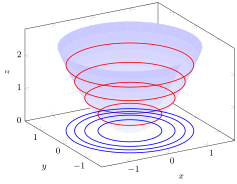
The level curves are circles of radius for . They appear in red on the graph of and in blue in the -plane.
-
Let be . Level sets are straight lines of slope : . All level sets are parallel lines.
Prerequisites
Related Concepts
Sources
- Math III: Analysis · Lecture 7
Aliases: level set, level curve, contour line Symbols: element of, real numbers, square root, subset
Last updated: 27 October 2026 11:52
Level Set and Level CurveRestriction of a FunctionSingleton SetImage and Preimage of a SetVector SpaceGradientDirectional DerivativeHyperplane