Exterior of a Set
Definition
For a metric space and a subset a point is an exterior point of if for some We denote the set of exterior points of as
The Open Metric Ball is a neighbourhood that avoids ; the empty Intersection of Sets expresses that no point lies in both the neighbourhood and .
Interpretation
An exterior point of is a point that is not only outside but keeps some distance from it: a small open ball around it misses completely. The exterior collects the points that are clearly outside , as opposed to outside points that still touches.
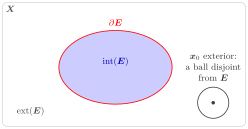
In the figure the shaded region is , the red curve is , and the rest of the rectangle is . The marked point has a ball that does not meet , exactly as the definition requires. The radius may be as small as needed, so a point close to the red curve but not on it is still exterior, only with a smaller ball.
The condition says the same as , so the exterior points of are the interior points of its complement: . Every point of is of exactly one of three kinds, so is the disjoint union . The points that are not exterior are precisely the adherent points of , which is why the closure is .
A common slip is to take every point outside as exterior. For in , the point is not in , but every interval contains points of , so is a boundary point. For in there are no exterior points at all, since every interval contains rational numbers.
Key Results
- An exterior point of can never be in
Examples
- For , the point is an exterior point. A small ball around , say , avoids .
- For , the point is an exterior point. A small disc around it stays entirely outside the unit disc.
Prerequisites
Related Concepts
Sources
- Math III: Analysis · Lecture 5
Aliases: exterior point Symbols: element of, epsilon, intersection, partial, rational numbers, real numbers, subset, union
Last updated: 20 October 2026 03:02
Exterior of a SetBoundary of a SetOpen Metric BallIntersection of SetsInterior of a Set