Weierstrass -test
Theorem
Suppose is a sequence of bounded functions on such that the series converges. Then, the series
The Uniform Norm is the smallest common upper bound on over all . Summability of these bounds is what makes the tail estimate independent of the input.
Interpretation
The -test reduces uniform convergence of a series of functions to convergence of one numerical series. Bound each term by a constant that is valid at every ; if converges, the series of functions converges uniformly. The smallest such constant is , so the theorem is stated with the uniform norms, and any larger summable bounds work by comparison.
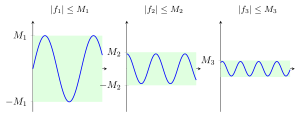
Each panel shows one term inside a band of half-width , and the bands shrink from panel to panel. The band bounds the whole graph of , not just its value at one point, which is what makes the estimate below independent of .
For partial sums and , the same bounds control every tail:
The right-hand side tends to zero independently of . For each fixed , the partial sums therefore form a Cauchy sequence of real numbers, so by the Cauchy criterion they converge, which gives a pointwise limit . Letting gives for all , so the convergence is uniform.
The hypothesis is normal convergence. The test is the standard tool for proving that a power series converges uniformly on closed intervals inside its radius, and that the Weierstrass function is continuous.
A common slip is to use a bound that depends on . On , with for each fixed , but this gives only pointwise convergence, and the geometric series is indeed not uniformly convergent there. The test is also sufficient, not necessary: the constant functions form a uniformly convergent series, although diverges.
Key Results
- The limit function is also bounded on .
- Due to the uniform limit theorem, if each is continuous, then the limit function is continuous.
Examples
- On , take . Since for every real , the bound holds simultaneously for all . The numerical series of bounds sums to , so the function series converges uniformly on :
For example, makes the error at most at every real , using the same number of terms everywhere.
Prerequisites
Related Concepts
Sources
- Math III: Analysis · Lecture 2
Aliases: M-test, Weierstrass test, m test Symbols: element of, infinity, real numbers, sum
Last updated: 20 October 2026 03:02
Weierstrass M-testUniform NormInfinite Series of FunctionsNormal ConvergenceWeierstrass Function