Third-Order Derivative Tensor
Definition
For a scalar function with third-order partial derivatives continuous on an open neighbourhood of (that is, is there), the third-order derivative tensor is the array
It represents the trilinear map
Interpretation
The third derivative tensor stores all third-order partial derivatives at a point, in the same way that the Hessian stores all second-order ones. Third-order partials carry three indices, so they fill a cube rather than a matrix.
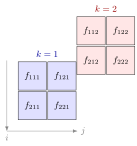
For the cube has entries , short for : picks the row, the column and the layer, with in front and at the back. For a function, entries whose indices are rearrangements of each other are equal (higher-order symmetry of partials), for example , so only four different values remain: , , and .
The array is used by feeding it vectors. Trilinear means linear in each of the three slots separately, just as is linear in and in . With the same displacement in all three slots, is the cubic term of the Taylor polynomial (tensor contraction for Taylor terms).
For from the Examples, , the three arrangements of equal and all other entries are . The sum is therefore , and the cubic term is : for a polynomial whose terms all have degree , the cubic Taylor term is the polynomial itself. A common slip is to count each mixed value once. In the sum, , and are separate entries with the same value, which is where the factor comes from.
Key Results
- For variables, the raw array has entries.
- If the third partial derivatives are continuous, many entries are equal by symmetry.
- Taylor's third-order term is obtained by feeding the displacement vector into the tensor three times.
Examples
- For , entries include , , and .
- For , all mixed third partials with one , one , and one equal .
Prerequisites
Related Concepts
Sources
- Math IV: Multivariate Calculus · Week 2, Lecture 1
Aliases: third-order tensor of derivatives Keywords: third derivative tensor, array of third partial derivatives Symbols: real numbers, subset, sum
Last updated: 27 October 2026 11:52
Third-Order Derivative TensorTensor Contraction for Taylor TermsHigher-Order Partial DerivativeVectorHigher-Order Symmetry of PartialsHessian Matrix