Similarity Transformation
Definition
Let and be real matrices. is similar to , written , if there is an invertible matrix with
The map is a similarity transformation. Some texts write instead; this only replaces by .
Interpretation
Similar matrices represent the same linear operator in different bases. If the columns of form a basis and is the matrix in standard coordinates, then is the matrix in -coordinates: convert to standard coordinates (), apply , convert back (). Here is the transformation matrix of , written on the change of basis page.
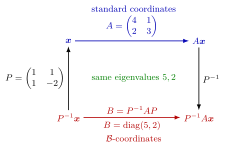
The square uses the diagonalization example below. Going up with , across with and down with gives the same result as going across the bottom with ; this is the identity . Both rows describe one operator, so its eigenvalues and appear in both: as the roots of the characteristic polynomial of and as the diagonal entries of .
Everything that describes the operator itself, rather than its coordinates, is therefore unchanged by similarity: eigenvalues, determinant, trace, rank. Eigenvectors are not invariant; they change coordinates along with everything else.
Two misconceptions. Equal invariants do not prove similarity (see the example below). And similarity is not row equivalence: for an invertible generally has different eigenvalues from .
Key Results
- Similarity is an equivalence relation on matrices.
- Similar matrices have the same characteristic polynomial, hence the same eigenvalues with the same algebraic multiplicities; geometric multiplicities, determinant, trace and rank also agree.
- If and , then .
- for all , and more generally for polynomials ; likewise for the matrix exponential.
- is diagonalizable if and only if it is similar to a diagonal matrix. Over , two matrices are similar if and only if they have the same Jordan normal form up to the order of the blocks.
- A real symmetric matrix is orthogonally similar to a diagonal matrix: with .
Examples
Diagonalizing. has trace and determinant , so eigenvalues and , with eigenvectors and . With
. This is a diagonalization of , and consequently .
Same invariants, not similar. and share characteristic polynomial , trace and determinant . But for every invertible , so they are not similar. An invariant that tells them apart is , which is for and for , because .
Prerequisites
Related Concepts
Sources
- Math V: Advanced Linear Algebra · Week 6
Aliases: similar matrices, matrix similarity, conjugation by an invertible matrix, similarity transform Keywords: B = P^{-1} A P, similarity invariants, same characteristic polynomial, A^k = P D^k P^{-1}, orthogonal similarity Symbols: complex numbers, lambda
Last updated: 22 October 2026 19:04
Similarity TransformationInverse and Singular MatricesEigenvalue and EigenvectorCharacteristic PolynomialChange of BasisDiagonalizationJordan Normal FormMatrix ExponentialSingular Value Decomposition