Stability of a System of Linear Difference Equations
Proposition
Let be a real matrix and consider the system with constant . The following are equivalent:
- every eigenvalue of , real or complex, satisfies ;
- as ;
- for every the solution of the homogeneous system satisfies .
In that case is not an eigenvalue, the equilibrium is unique, and every solution converges to it: the equilibrium is (globally) asymptotically stable.
Interpretation
When an equilibrium exists, the deviation from it evolves as . For a diagonalizable matrix it is a sum of terms , and each dies out exactly when the modulus is below . In general the Jordan normal form adds factors , which do not change the conclusion. This is the matrix version of the scalar criterion .
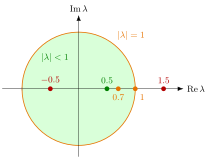
The figure plots the eigenvalues of the three examples below. The first matrix has the single eigenvalue (green), inside the unit circle, so the system is asymptotically stable. The second has inside but outside (red), and one eigenvalue outside is enough for instability. The third has inside and on the circle (orange): solutions stay bounded and converge, but not to a single equilibrium.
Complex eigenvalues must be included: a conjugate pair produces oscillating modes with factors and . The rotation-scaling description uses eigenvector coordinates, which need not be orthonormal. A common mistake is to inspect the entries of instead of its eigenvalues; small diagonal entries do not imply stability unless is triangular.
Asymptotic stability of a specified equilibrium means that deviations from it tend to zero; merely converging to a limit that depends on the initial state is insufficient. For the homogeneous system, all trajectories stay bounded if and only if all and every eigenvalue with has equal algebraic and geometric multiplicity. This boundedness criterion also applies to the affine system when an equilibrium exists, by subtracting it. Without an equilibrium, constant forcing can cause unbounded drift even when this spectral condition holds: has .
Key Results
- For the homogeneous system, a nonzero initial state on an eigenvector with (or in its real invariant plane, for a complex pair) grows without bound. Initial states in the span of the generalized eigenvectors with tend to zero. For an affine system with an equilibrium, apply these statements to the initial deviation , not to itself.
- Eigenvalues with exclude asymptotic stability: gives constant modes, a two-cycle, a nonreal pair a bounded oscillation with nondecaying amplitude in its invariant-plane coordinates.
- For : both eigenvalues lie inside the unit circle if and only if and (the determinant and trace are the product and sum of the eigenvalues).
- Necessary condition for any : , since .
- A scalar equation of order is (asymptotically) stable if and only if its companion matrix is, since the eigenvalues are the characteristic roots (higher-order equation).
Examples
Asymptotically stable, not diagonalizable. , . The only eigenvalue is , so the system is asymptotically stable. Solving gives ; check: . Here , and despite the factor .
Small diagonal, unstable. has , and eigenvalues and . Unstable; the test agrees, since .
Boundary case. For with the column-stochastic matrix of a two-state Markov chain the eigenvalues are and . Solutions converge, but to a limit that depends on (a multiple of ), so the zero solution is not asymptotically stable. It is stable: both eigenvalues are simple and , so all solutions stay bounded.
Prerequisites
- System of Linear Difference Equations
- Stability of a Scalar Difference Equation
- Eigenvalue and Eigenvector
- Complex Absolute Value
Related Concepts
- Complex Conjugate Pair of Eigenvalues
- Higher-Order Linear Difference Equation
- Stability of an Equilibrium
- Jordan Normal Form
- Markov Chain
Sources
- Math V: Advanced Linear Algebra · Week 2
Aliases: stability of a linear discrete-time system, asymptotic stability of x_{t+1} = A x_t Keywords: all eigenvalues of modulus less than 1, spectral radius below 1, A^t -> 0, |det A| < 1 and |tr A| < 1 + det A, unit circle Symbols: element of, infinity, lambda, product, real numbers, rho, theta
Last updated: 27 October 2026 11:52
Stability of a System of Linear Difference EquationsSystem of Linear Difference EquationsStability of a Scalar Difference EquationEigenvalue and EigenvectorComplex Absolute ValueComplex Conjugate Pair of EigenvaluesHigher-Order Linear Difference EquationStability of an EquilibriumJordan Normal FormMarkov Chain