Second-Order Differential Equation
Definition
A second-order differential equation is a differential equation in which the second derivative is the highest higher-order derivative of the unknown that occurs; explicitly, , where .
It is linear if it can be written as
with constant coefficients if are constants, and homogeneous if . An initial value problem prescribes two initial conditions, and .
Interpretation
The state of a second-order system at time is the pair , position and velocity in mechanics. Knowing only is not enough: a pendulum released at the same position with different velocities moves differently. This is why two constants appear in the general solution, compared with one for a first-order differential equation.
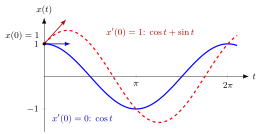
Both curves solve and start at the same position . With the solution is , as in the first example below; with the conditions give , , so . The arrows show the two initial slopes: the same position with a different velocity gives a different solution, so both and must be prescribed.
Setting and rewrites the constant-coefficient equation as a first-order system
The eigenvalues of this companion matrix satisfy , which is the characteristic equation of the scalar equation. Here the scalar and the matrix viewpoints meet.
A frequent slip is to treat the equation as linear when or enters nonlinearly, as in (the exact pendulum) or .
Key Results
- If are continuous on an interval , each initial value problem with , has exactly one solution on .
- The solutions of the homogeneous linear equation form a two-dimensional vector space.
- Every solution of the inhomogeneous equation is , with a particular solution and independent homogeneous solutions.
- For constant coefficients, the homogeneous solutions come from the roots of .
Examples
Undamped oscillation. with , . The functions and solve it, so ; the conditions give , , hence .
Distinct real roots. with , . Roots of are , so . Then and , giving , : . Check: .
Repeated root. has , a double root , and the solution basis , .
Pure forcing. with a constant (free fall under constant gravity) with , integrates twice to .
Prerequisites
Related Concepts
- Characteristic Equation for a Differential Equation
- Particular Solution of an Inhomogeneous Linear ODE
- System of Differential Equations
- Second Order Linear Difference Equation
Sources
- Math V: Advanced Linear Algebra · Week 4
Aliases: Second Order Differential Equation, second-order ODE, second order ODE Keywords: x''(t)+a_1 x'(t)+a_0 x(t)=g(t), two initial conditions, companion matrix, harmonic oscillator, damped oscillation Symbols: lambda
Last updated: 14 October 2026 08:21
Second-Order Differential EquationCharacteristic Equation for a Differential EquationParticular Solution of an Inhomogeneous Linear ODEDifferential EquationFirst-Order Differential EquationHigher-Order DerivativeVector SpaceSystem of Differential EquationsSecond-Order Linear Difference Equation